An international study published in Nature Communications* to which Teresa Rodrigues a researcher at IPMA and a member of the CCMAR research team, contributed, reveals that the answer may lie deep within the ocean.
The research analysed Termination IV, a period during which the Earth transitioned from an ice age to a warmer climate. While it was known that this transition was accompanied by one of the fastest recorded episodes of sea-level rise in geological history, the mechanisms that triggered the thaw were not well understood.
Was it primarily caused by more intense solar radiation, higher levels of CO₂ in the atmosphere, unstable ice sheets, or changes in the ocean? One of the main obstacles to answering this question was the inability to establish the chronology of these phenomena. Without this information, scientists could not determine a cause-and-effect relationship.
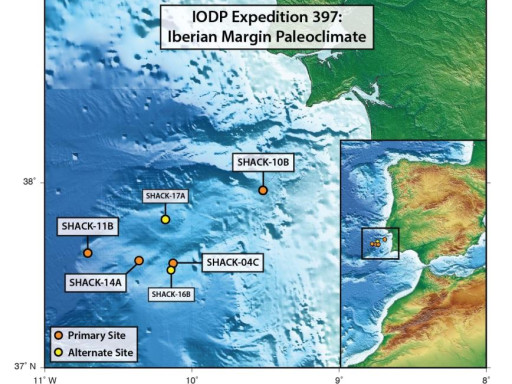
To reconstruct this sequence of events, the international team combined two types of natural climate archive. Firstly, they used records preserved in speleothems from a cave in northern Italy, which had been dated with high precision. They also analysed marine records from the North Atlantic, including reconstructions of ocean surface temperature derived from biomarkers preserved in sediments from the Iberian Margin — a study in which Teresa Rodrigues participated.
The answer lies in the heat accumulated by Atlantic Ocean currents
During this period, the ocean ceased to redistribute heat efficiently, resulting in its accumulation in the ocean's deepest layers. The researchers termed this process the 'delayed release mechanism'.
According to the researchers, this stored heat acted as an ‘invisible heat reservoir’. Once ocean circulation had recovered, the accumulated energy was released into the surface waters and the atmosphere. This accelerated the melting of the large polar ice caps and contributed to an exceptionally rapid rise in sea level. Rising concentrations of atmospheric carbon dioxide and increased solar radiation in the Northern Hemisphere are thought to have reinforced this process.
Rather than merely providing an answer about the past, the study shows that ocean circulation can actively influence the rate at which sea levels rise. Rather than passively responding to global warming, ocean circulation can store, transport, and release heat in ways that amplify ice loss.
The study presents new insights into ice mass loss in Greenland and Antarctica
These findings are particularly significant in the context of climate change. Currently, both regions are losing ice mass, while observations and climate models suggest that Atlantic circulation could weaken further in the coming decades. If this were to favour the accumulation of heat within the ocean once again, the melting could occur more rapidly and in a less predictable way than expected.
Led by Hsun-Ming Hu of the Chinese Academy of Sciences and National Taiwan University, the study brought together researchers from Europe and Asia. CCMAR's contribution involved reconstructing North Atlantic surface temperatures by analysing organic biomarkers preserved in marine sediments collected during the IODP 339 international expedition.